Industry knowledge
Alahot demonstrates practical full-stack engineering by combining sensor hardware, embedded control, communication firmware and cloud software to deliver App Pressure Control Solenoid Valves that react precisely to changing pressures while minimizing power draw and maintenance overhead.
Sensor fusion and placement strategies
Accurate pressure feedback begins with sensor selection and placement. Alahot pairs MEMS pressure sensors with temperature compensation and optional differential sensing to avoid false triggers caused by thermal drift. Sensor placement follows fluid-dynamics analysis: install a primary sensor at the manifold outlet for control loops and a secondary sensor downstream for fault detection and cross-checking. Redundant sensing allows the valve controller to reject spurious readings and keep the system stable.
Embedded control: deterministic loops and low-power modes
Onboard microcontrollers run deterministic PID or model-predictive loops tuned for valve dynamics. To reduce power consumption in battery-powered deployments, Alahot implements hierarchical control: a low-frequency supervisory loop runs continuously for safety, while high-frequency modulation activates only when pressure deviation exceeds thresholds. Sleep states are used for sensors and radios, with wake-on-event to preserve responsiveness.
Practical tuning tips
- Begin with conservative proportional gains, then increase integral only after the system shows stable phase margin.
- Use step tests to identify valve dead time and incorporate feedforward compensation for fast disturbances.
- When deploying in multi-valve systems, add coordination logic to avoid pressure hunting from simultaneous corrections.
Communication protocols and app integration
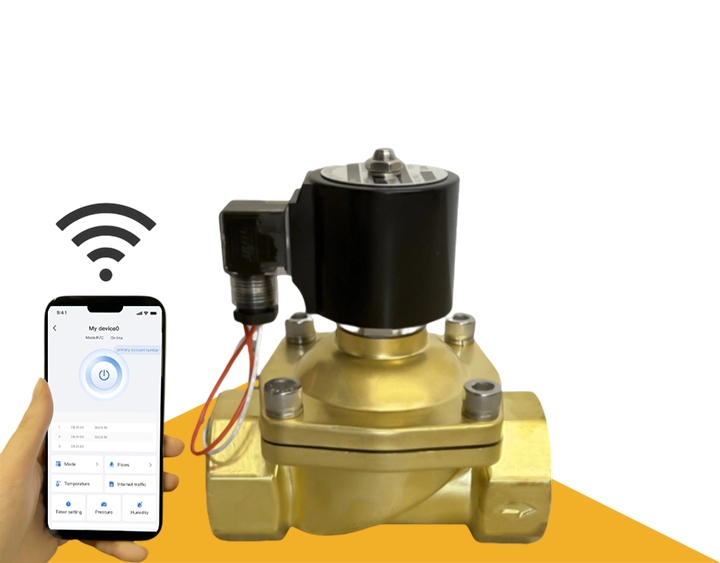
Alahot supports multiple stacks—Bluetooth Low Energy for local setup, LoRa/4G for remote sites, and Modbus/TCP for industrial controllers. The mobile app provides secure over-the-air parameter updates, visible time-series of pressure and valve position, and configurable alerts. App-level logic can host user presets that the valve controller enforces locally when connectivity is lost.
Security and reliability measures
- Mutual authentication between valve and app using certificate-based TLS for remote links.
- Fail-safe modes: valves default to a safe position on controller fault, with a timed retry and alarm escalation.
- Local control fallback: critical control loops remain on the embedded controller instead of relying solely on cloud commands.
Mechanical design choices for long-term performance
Material selection and compact form factors reduce corrosion and enable installation in constrained spaces. Alahot uses corrosion-resistant alloys or coated internals based on media chemistry, and seals rated for expected temperatures and media. Mechanical actuation is optimized to balance response speed and lifetime through low-friction guides and controlled coil current profiles to minimize wear.
Diagnostics, maintenance and remote troubleshooting
Diagnostics stream essential details rather than raw traces: valve position, coil current signature, pressure residuals, and battery health. The app aggregates these into actionable alerts with suggested corrective steps—calibration, filter cleaning, or part replacement. For complex issues, an auto-generated diagnostic package can be exported for engineering analysis.
| Capability |
Practical benefit |
Deployment example |
| Local PID + App Presets |
Continued control during network outages |
Remote irrigation blocks |
| Coil current monitoring |
Early detection of sticking or friction |
Municipal water lines |
| Over-the-air firmware |
Rapid feature rollouts and security patches |
Smart building HVAC |
Application-specific integrations and examples
For battery-powered irrigation, firmware emphasizes energy-aware sampling and scheduled wake windows; App Pressure Control Solenoid Valves can operate for months on a single battery with adaptive sleep. In HVAC, tight hysteresis control combined with app-driven setpoint schedules reduces cycling and improves comfort. For medical devices requiring ultra-quiet operation, Alahot co-engineers miniature assemblies with damped actuation profiles and noise-optimized coils.
Design-for-integration checklist
- Define control authority: which commands the app can override and what remains local.
- Specify communication fallbacks and expected latency for control-critical signals.
- Include diagnostic endpoints and minimum telemetry for remote fault triage.
- Select materials and seals aligned with media chemistry and maintenance cadence.
Combining hardware discipline with pragmatic software features yields App Pressure Control Solenoid Valves that are not only smart on paper but reliable in the field—delivering measurable uptime improvements, simplified maintenance, and predictable performance.



 English
 Español

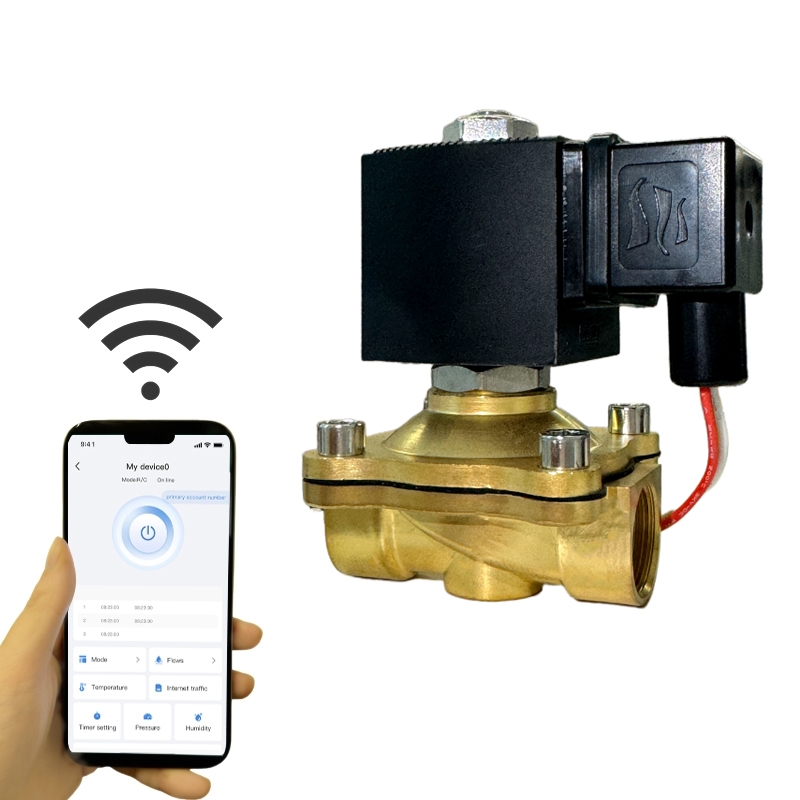 Brass App Pressure Control Solenoid Valve integrates pressure sensing and app-based control to support intelligent pressure regulation in fluid systems. With built-in support for NB-IoT, MODBUS, and o...
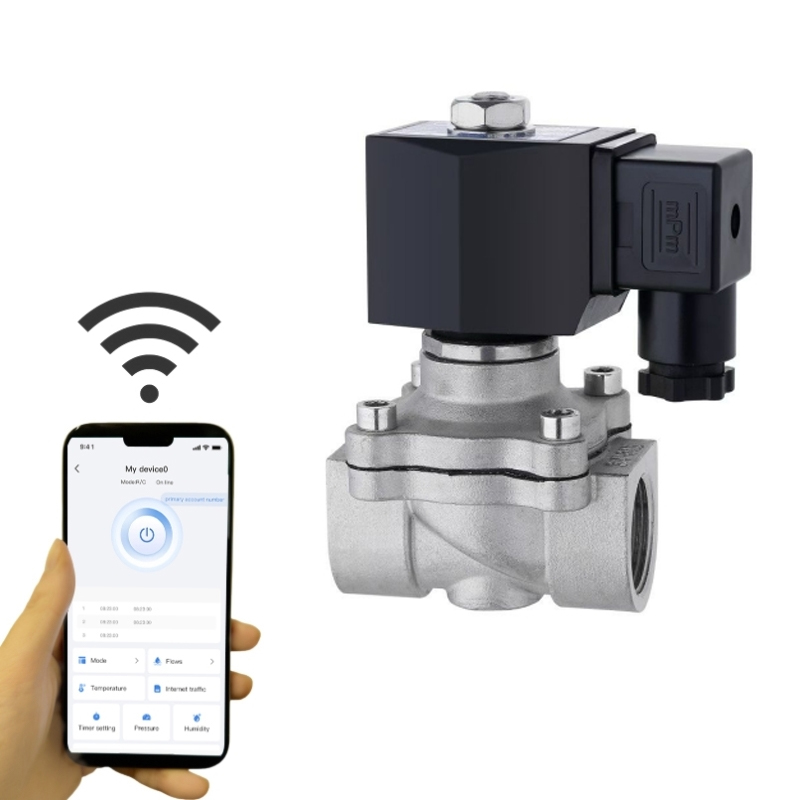 304 Stainless Steel App Pressure Control Solenoid Valve offers automated pressure regulation through app-based remote control and integrated pressure sensing. Designed for precision fluid control in d...
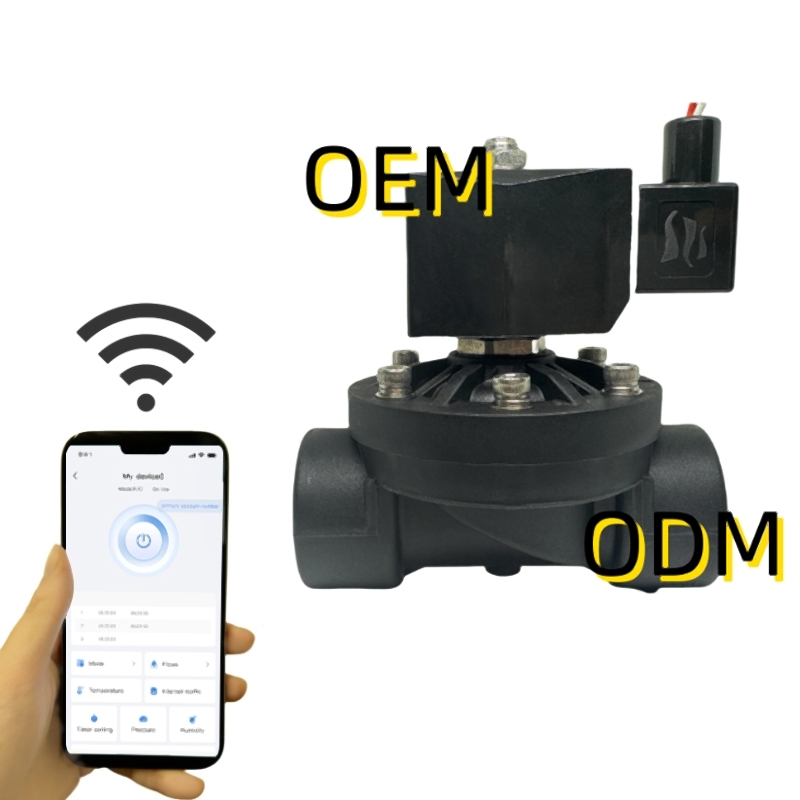 Plastic App Pressure Control Solenoid Valve integrates remote pressure sensing with app-based control to deliver responsive pressure regulation in low to medium demand systems. The lightweight plastic...